Table of Contents
Cayuga County Courts, NY *
Seamlessly navigating the court system is one of the greatest sources of confidence for the residents of Cayuga County. Like any other county in New York, Cayuga County is under the State Unified Court System, which is a layered system with different courts that deal with all the legal issues affecting the people. However, with a basic understanding of the design and how it operates, one can easily find records of a previous case, file paperwork, or track the stage of an ongoing case.
This situation is only achievable if each party to a case can independently initiate case filing and flawlessly finish the process. The courts are classified according to their complexity and the amount of dollars being claimed. For example, the case of a traffic ticket is handled differently from a tenant-landlord dispute. Understanding the difference in court operations enables one to save time and reduce the chances of losing a case.
Overview of the Cayuga County Court System
The New York State Unified Court System has standardized rules involving access to records, types of cases, and filing statewide. The standardization is meant to streamline its justice system. The unified system sets the administrative structure for Cayuga County, whose courts form part of New York's Seventh Judicial District. Cayuga strictly operates within the judicial authority created by New York State.
The courts where typical cases would land in Cayuga include Justice Courts (Town and Village Courts) at the lowest level, City Court, Surrogate's Court, Family Court, County Court, and the Supreme Court. Often, cases get transferred or dismissed when people are uninformed that each of these courts has its own jurisdiction. In any case, the Supreme Court handles high-stakes civil matters.
Types of Courts in Cayuga County, New York
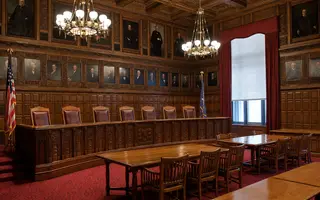
Cayuga County has a layered judicial system without overlapping functions or responsibilities. Their jurisdictions are dependent on their geographical span, the type of case they handle, and the magnitude (monetary equivalence).
 Supreme Court
The Supreme Court in Cayuga County is the superior court in the county based on its unlimited jurisdiction. It remains the general trial court with the power to determine any case brought before its bench. With the Seventh Judicial District assuring its commitment to enhance access to Justice, the Supreme Court continuously hears the following cases:
- Serious felony crimes
- Major civil cases
- Divorce and separation
- Determines cases from the lower-level court, especially the County Court
- High-stakes commercial cases
The court handles custody and divorce cases in which high-value assets are involved. It determines cases in which individuals petition government agency decisions.
Primary Location: Cayuga County Courthouse
 County Court
The County Court is the second-ranked court in Cayuga County and has the power to conduct trials for felony crimes. Most people in a lawsuit visit this court for reasons that may include a pretrial hearing, a trial, an appeal from a lower court, or an arraignment. The County Court handles the following cases:
- Civil cases with a monetary equivalent of up to $25,000
- Felony crimes
- Appeals from lower courts
- Misdemeanors and violations
The County Court may handle certain unique cases, such as those that involve drug administration and other specialized docket, provided it has judicial resources and the caseload ranges within its jurisdiction.
Primary Location: Cayuga County Courthouse
 Family Court
This court deals with cases involving families and children. Family Court happens to be the one where the highest number of residents attend without any legal personnel to assist them with navigating the process. For this reason, the court maintains a self-help center to cushion them against the complex proceedings usually witnessed when the stakes are high, and when matters revolve around child protection.
Some of the issues handled by this court include the following:
- Juvenile delinquency
- Domestic violence
- Child support
- Paternity cases
- Child custody and visitation
The Family Court may entirely handle neglect or abuse allegation cases against parents. However, it has an exclusive jurisdiction, especially on matters linked to children in the child welfare system.
Primary Location: Cayuga County Courthouse
 City Court
Auburn City Court is the only city court in Cayuga City. Unless a charge has been raised to become a felony, most Auburn City residents have their cases heard in this court. According to the New York State Unified Court System, the Auburn City Court decides on the following cases:
- Misdemeanor violations
- Traffic infractions
- Small claims up to a limit of $5,000
- Civil cases up to a limit of $15,000
- Commercial claims not exceeding $3,000
- Landlord-tenant disputes
It is worth noting that this court operates within its jurisdiction within Auburn City.
Primary Location: Cayuga County Courthouse
 Surrogate's Court
The Surrogate's Court is involved after the demise of an individual without a will, causing problems with the distribution of their estate. To distribute the left assets, the Surrogate's Court appointed administrators and executors to assist in the litigation process by starting it formally in the court. Specifically, the court handles the issues of:
- Probate of wills
- Estates administration
- Adoption and guardianship for minors
The litigation process may take a long time, depending on the value of the contested assets and the number of supposed beneficiaries. Having knowledge in this process is imperative, as it could help to shorten the time taken to determine the case because the involved parties will be informed of the required documentation.
Primary Location: Cayuga County Courthouse
 Town & Village Justice Courts
There are many Justice (Town and Village) Courts across Cayuga County, which continuously handle cases as they arise. They perform similar functions, except their administration of justice is limited to their respective jurisdictions. At the local level, Town and Village Courts handle cases such as:
- Landlord-tenant disputes
- Traffic violations
- Small claims
- Misdemeanors
Primary Location: Town and Village Courts
How to Access Cayuga County Court Records
Like other counties in New York State, Cayuga County ensures its court records remain public, and citizens are allowed to access them, with the exception of those involving minors, juvenile delinquency cases, family proceedings, and those sealed and marked as confidential. The following are some of the ways through which the public may access court records:
 Online Access
Cayuga County courts have various online portals to enable easy access to court records for the public. For example, for civil cases filed at the Supreme Court, using New York State Courts Electronic Filing (NYSCEF) could help, as it is used to update case status after a filed petition. Additionally, one may explore eCourts. Using this tool, an individual may search for details of a case using the index number or the name of an attorney, among other search criteria.
 Alternative Online Options
Using a third-party tool like CourtCaseFinder also goes a long way for any person who wishes to search for Cayuga County court records. This tool aggregates information from different sources, including multiple government portals, regardless of the level of the court where the case was filed, heard, or determined.
 In-Person Requests
This method specifically works when an individual is looking for certified documents, which are typically unavailable online. In Cayuga County, these documents are maintained by the County Clerk, whose offices are located in Auburn City. Upon request, this office is cooperative and may share the documents at a modest fee. It is worth noting that separate clerk offices handle these records in the Surrogate's Court from the Family Court. Usually, one is advised to communicate before visiting to avoid the inconvenience that may arise from trying to relocate the document.
 Archived Records
Depending on how long since the document was authored, New York State may have the records that are no longer in use within the local courthouse or transfer them to the New York State Archives in Albany. In practice, the archive offers secure storage, especially for records relating to landmark civil case judgments.
For Attorneys and Legal Professionals
As a standard rule, to file civil cases, the Supreme Court insists on submission using New York State Courts Electronic Filing (NYSCEF) for the relevant case types filed through this platform. The platform allows them to file their cases on time and get a real-time case update notification. Apart from the filing system, the lawyers can access court records of their ongoing cases through the eCourts, which allows them to search for details of a case using the index number or the name of an attorney, among other search criteria.
With the support of the Seventh Judicial District, which is the administrative unit, there are guaranteed legal professionals to guide court proceedings and assist with procedural questions, since scheduling information and calendars are available at the administrative offices in Auburn. Lastly, attorneys should take time and check the 7th Judicial District Judges' Rules, which have specific rules and procedures to be followed in specific court processes.
How to File a Case in Cayuga County
To avoid mistakes that could jeopardize a case, it is imperative to be sufficiently knowledgeable about the procedure for filing a case in Cayuga County.
Step 1: Choose the Correct Court
Here, the correctness of a court is determined by the underlying features of the case. For instance, in Cayuga County, civil cases are primarily filed at the Supreme Court or at the Auburn City Court. However, if the petition has a monetary equivalent of $15,000, the case will not be successfully filed at the City Court, as it lacks the jurisdiction to hear this case. Therefore, it is important to know the correct court to avoid chances of the case being transferred or dismissed. More information on this step may be found on the New York State Unified Court System.
 Step 2: Complete Required Forms
Usually, each case type presents a unique set of requirements that requires one to ensure they complete the correct form. It is vital to be sure to get it right at this point to avoid time wastage and potential confusion. For example, the Small Claims form is required when filing a small claims case, while the Summons and Complaint are the initial forms for filing a civil case at the High Court. At this point, getting the forms ought to be effortless, thanks to the courts' decision to have the Forms available online.
 Step 3: File the Case
Once the forms are completed appropriately, be sure to file them in the prescribed format. For instance, one may present them at the clerk's desk, where they will be stamped appropriately. Otherwise, for a civil case being filed at the Supreme Court, use the New York State Courts Electronic Filing (NYSCEF). Litigants representing themselves are able to use the platform.
 Step 4: Pay Filing Fees
The relevant fee is paid to the court where an individual makes the application. This fee varies based on the court level and the filed case. For instance, a $210 fee is payable at the Supreme Court, while small claims courts could require about $10 to $20. People who may not afford the fee are advised to apply for a waiver by submitting the Application to Waive Court Costs, Fees, and Expenses and having it approved.
 Step 5: Serve the Other Party
Service of process, which involves formal notification to the opposing party, should follow. There are standardized modes to use in conveying this information, which depend on the case type. Usually, court clerks inform of the rules to follow when serving the other party in Family court petitions. Whereas sending it via email works for smaller claims. Process servers are used for civil petitions at the Supreme Court. A proof of service must be filed back with the court for a case to proceed.
 Step 6: Monitor the Case
Finally, having taken every step correctly, the court schedules the appearance dates, which parties must strictly adhere to. Noncompliance may lead to a default judgment, dismissal, or arrest warrant. Use tools such as eCourts in tracking the case.
Cayuga County Courthouse Directory
Like many counties in New York State, Cayuga presents a unique case with multiple courts in the same area.
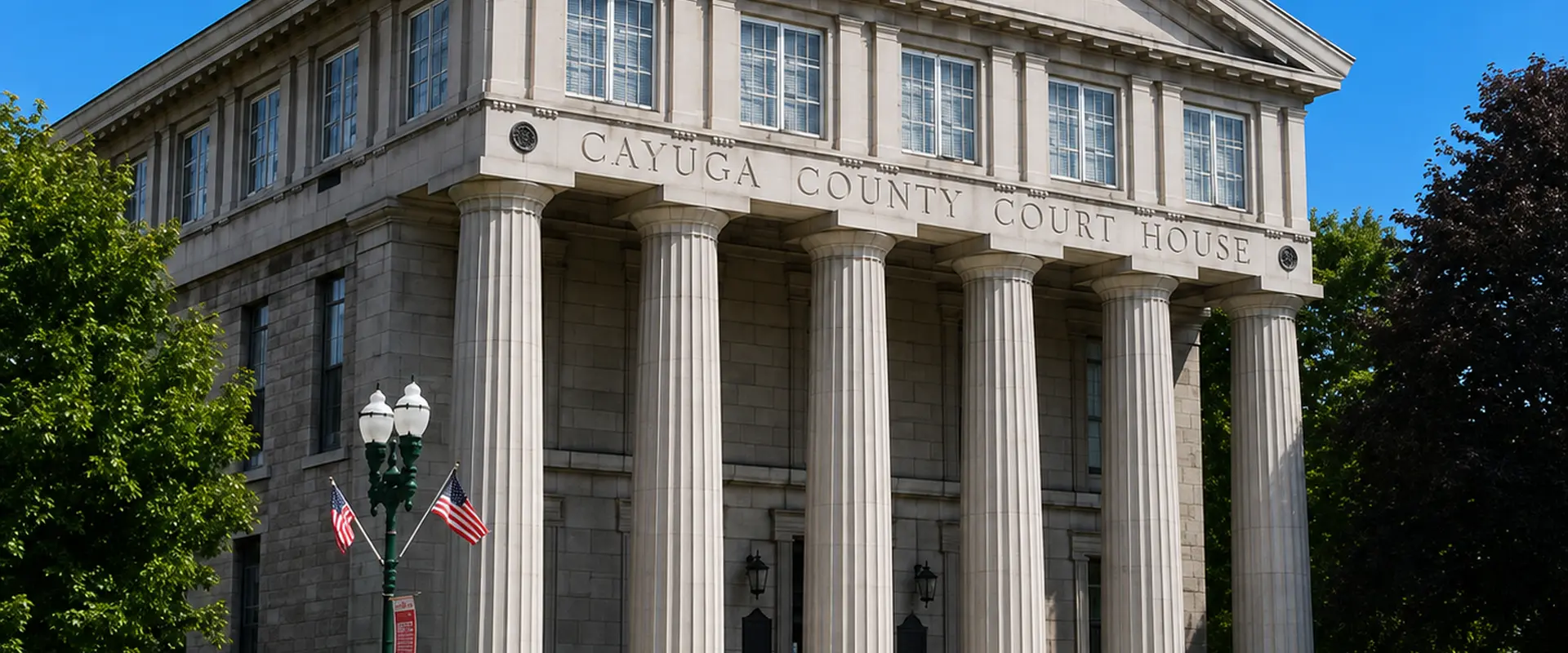
Cayuga County Courthouse
Hosts the Supreme Court, County Court, and Surrogate's Court.
Auburn
Address: 152 Genesee Street, Auburn, NY 13021
Supreme Court: (315) 237-6450
County Court: (315) 237-6450
Surrogate's Court: (315) 237-6210
Family Court
Handles issues involving children and families.
Auburn
Address: 157 Genesee Street, Auburn, NY 13021
Phone: (315) 237-6400
Website: nycourts.gov/courts/7th-judicial-district/cayuga-county-family-court-m-b
Auburn City Court
Auburn City Court is the only city court in Cayuga County.
Auburn
Address: 157 Genesee Street, Auburn, NY 13021
Phone: (315) 237-6420
Website: nycourts.gov/courts/7th-judicial-district/auburn-city-court
Town and Village Courts
The Town and Village Courts comprise a network of courts with limited jurisdiction spread across Cayuga County. These trial courts handle cases involving evictions, minor criminal offenses, small claims, and traffic matters within the scope of their geographical boundaries. Thanks to New York State, all the contact information can be accessed via one website link below:
Legal Help and Self-Help Resources
Some people are represented by legal professionals in court. However, others, without that privilege, find themselves in risky positions due to the complexities of the ongoing proceedings. Therefore, preparing to get assistance goes a long way.
 Free Legal Assistance
In Cayuga County, some organizations provide free legal assistance in civil cases to individuals with very low or no income. For instance, the Legal Aid Society of Mid-New York assists in this way. Additionally, there are teaching programs in the form of guides and videos aimed at educating litigants who represent themselves. Notably, New York State has implemented this program through the Self-Help Center.
Local Legal Support
The first place people can get support is the Cayuga County Bar Association, which connects residents to attorneys who practice in the county. In most cases, the lawyers offer a low initial cost, making it affordable to the people. Also, there are periodic legal clinics hosted at the courthouse in Auburn for pro se litigants. While availability varies significantly, the county plans to create channels for people to inquire about upcoming clinic dates in advance and find a way to create more such opportunities.
FAQs
How do I search for a criminal case in Cayuga County?
There are different ways of searching for a criminal case in Cayuga County. Using tools like CourtCaseFinder works well, and it offers certain advantages. For instance, it aggregates various portals, including government websites, making it possible to find a case even if one is unsure of the specific court in which a case was handled.
Are court records public in Cayuga County?
Court records in Cayuga County are public because they are of public interest. However, there are specific exceptions to making court records public. For example, matters involving minors, juveniles in delinquency proceedings, family cases, and cases sealed as confidential are usually not made public as they tend to contain sensitive information about other people.
Are online court record searches always accurate?
Online court records from official sites like eCourts are typically accurate, though there can be minor errors in spellings and such. Uploaded information to such sites usually comes from the clerk, who is the custodian of all court records. As such, they are the first people to get updates whenever there is a change in the status of a case or record. Therefore, it is within their means to ensure the accuracy of online records.
When is it helpful to use a third-party records finder?
Sometimes, one is uncertain about the specific court or jurisdiction where a case was handled, which makes it challenging to get a record using the courts' mainstream tools. However, by using third-party tools like CourtCaseFinder, it becomes easier to get the record because these tools collect data from multiple sites online, including government portals.
What do I do if I can't find my case online?
Various reasons may make the case unavailable online. Notably, despite not finding it online, one can visit the clerk's desk and request the details of the case. At the clerk's desk, an individual may request that the personnel give them a copy of the case at a modest fee or ask for the information to be shared with them via email.
Other Counties in New York
- Albany
- Allegany
- Bronx
- Broome
- Cattaraugus
- Chautauqua
- Chemung
- Chenango
- Clinton
- Columbia
- Cortland
- Delaware
- Dutchess
- Erie
- Essex
- Franklin
- Fulton
- Genesee
- Greene
- Hamilton
- Herkimer
- Jefferson
- Kings
- Lewis
- Livingston
- Madison
- Monroe
- Montgomery
- Nassau
- New York
- Niagara
- Oneida
- Onondaga
- Ontario
- Orange
- Orleans
- Oswego
- Otsego
- Putnam
- Queens
- Rensselaer
- Richmond
- Rockland
- Saint Lawrence
- Saratoga
- Schenectady
- Schoharie
- Schuyler
- Seneca
- Steuben
- Suffolk
- Sullivan
- Tioga
- Tompkins
- Ulster
- Warren
- Washington
- Wayne
- Westchester
- Wyoming
- Yates
Table of Contents